We have already stated where B2B eCommerce is headed in our 2026 predictions series. This blog goes deeper into why those shifts are happening and what is actually forcing change.
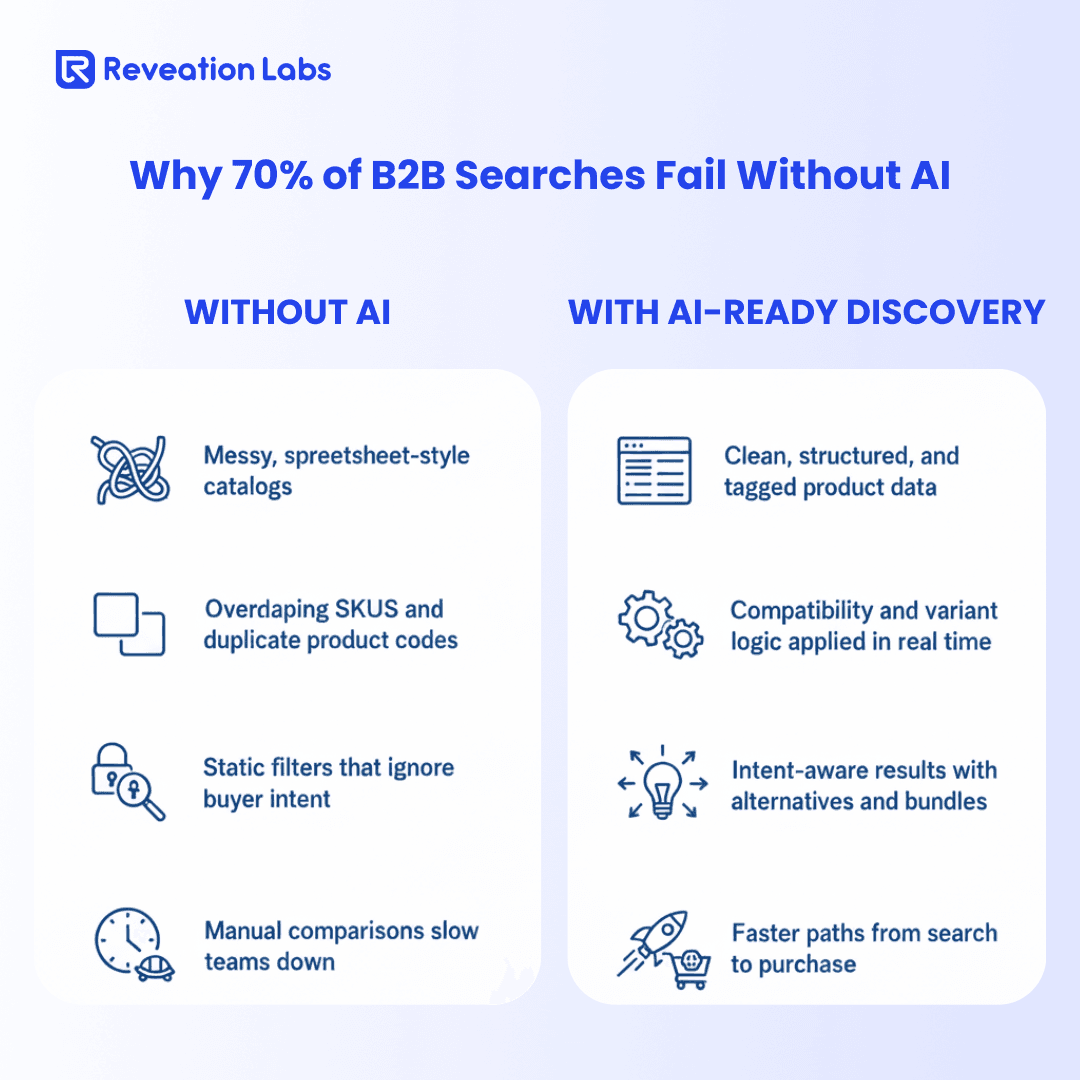
70%
B2B buyers still struggle to find relevant products once they land on a site.
Discovery
The issue is not demand. It is a discovery.
2026
AI-ready discovery becomes a competitive requirement.
Sales projections look strong, yet nearly 70 percent of B2B buyers still struggle to find relevant products once they land on a site.
The issue is not demand. It is a discovery.
Traditional keyword search is struggling to keep up with modern B2B complexity. Buyers are no longer searching for “forklift parts.”
They are asking contextual questions about load capacity, contract terms, and alternatives. Keyword-based systems were never designed for this.
Product discovery has shifted from search to conversation. AI copilots and LLM-driven tools are redefining how buyers explore large catalogs, applying consumer-grade expectations to enterprise buying logic.
This shift hits mid-market manufacturers and distributors the hardest. Catalog management of thousands of SKUs, custom pricing tiers, and fragmented product data while delivering high-relevance results is now table stakes.
The B2B ecommerce trends shaping 2026 are deeply connected. AI-optimized content, headless architectures, and composable commerce are not standalone upgrades.
These are the B2B eCommerce solutions that change how buyers discover, evaluate, and purchase products.
From SEO to GEO: The Most Critical B2B Ecommerce Trend
Visibility gap
Are your product pages invisible to AI engines? If you're still optimizing for Google's 2015 algorithm, you're missing 40% of potential conversions.
Generative Engine Optimization (GEO) is replacing traditional SEO as the dominant visibility strategy.
Unlike keyword-stuffed content, GEO focuses on semantic depth, authoritative signals, and structured data that large language models can parse and trust.
When a buyer asks ChatGPT or Claude about industrial parts, does your catalog appear in the answer?
SEO vs. GEO: What Manufacturers Need to Know
Primary Focus
SEO (Traditional): Keywords, backlinks
GEO (AI-Ready): Semantics, authority signals, citations
Typical Buyer Query
SEO (Traditional): "forklift parts"
GEO (AI-Ready): "Best forklift parts for 5-ton industrial load"
Visibility Impact
SEO (Traditional): 20% standard reach
GEO (AI-Ready): 40% conversion uplift potential
Required Tools
SEO (Traditional): Google Analytics, Search Console
GEO (AI-Ready): Schema.org, entity tagging, Q&A formatting
Content Depth
SEO (Traditional): 500-word product descriptions
GEO (AI-Ready): In-depth, conversational content with context
How manufacturers should adapt
- Product data needs to go beyond basic descriptions. Each product variant should be tagged with detailed compatibility information such as model numbers, manufacturing years, load capacity, and use cases.
- For example, if you sell Toyota forklift components, structure your content to clearly answer questions like: Which parts fit Toyota 8FGU25 models manufactured between 2018 and 2023?
- Add schema markup for specifications, pricing tiers, and cross-compatibility, so AI systems can accurately understand and surface your products in conversational discovery.
How distributors should adapt
- Pricing information should no longer be hidden behind internal logic. Tiered and contract-based pricing needs to be exposed dynamically through structured data.
- AI engines must be able to interpret volume discounts, regional availability, and customer-specific B2B pricing rules. Use Q&A-style content that mirrors how buyers actually ask questions about pricing, availability, alternatives, and delivery timelines.
AI Copilots: Cutting Search Steps in Half
What if your buyers never used your search bar again? That shift is already underway.
By 2026, most shoppers will rely on AI tools to guide purchases, with AI agents driving meaningful lifts in online sales through personalized recommendations.
AI copilots change how discovery works. They cut navigation steps in half by understanding context, purchase history, and real-time inventory.
For B2B buyers navigating catalogs with over 10,000 SKUs, this is not a nice-to-have. It is a competitive requirement.
Real Business Impact for Distributors and Manufacturers
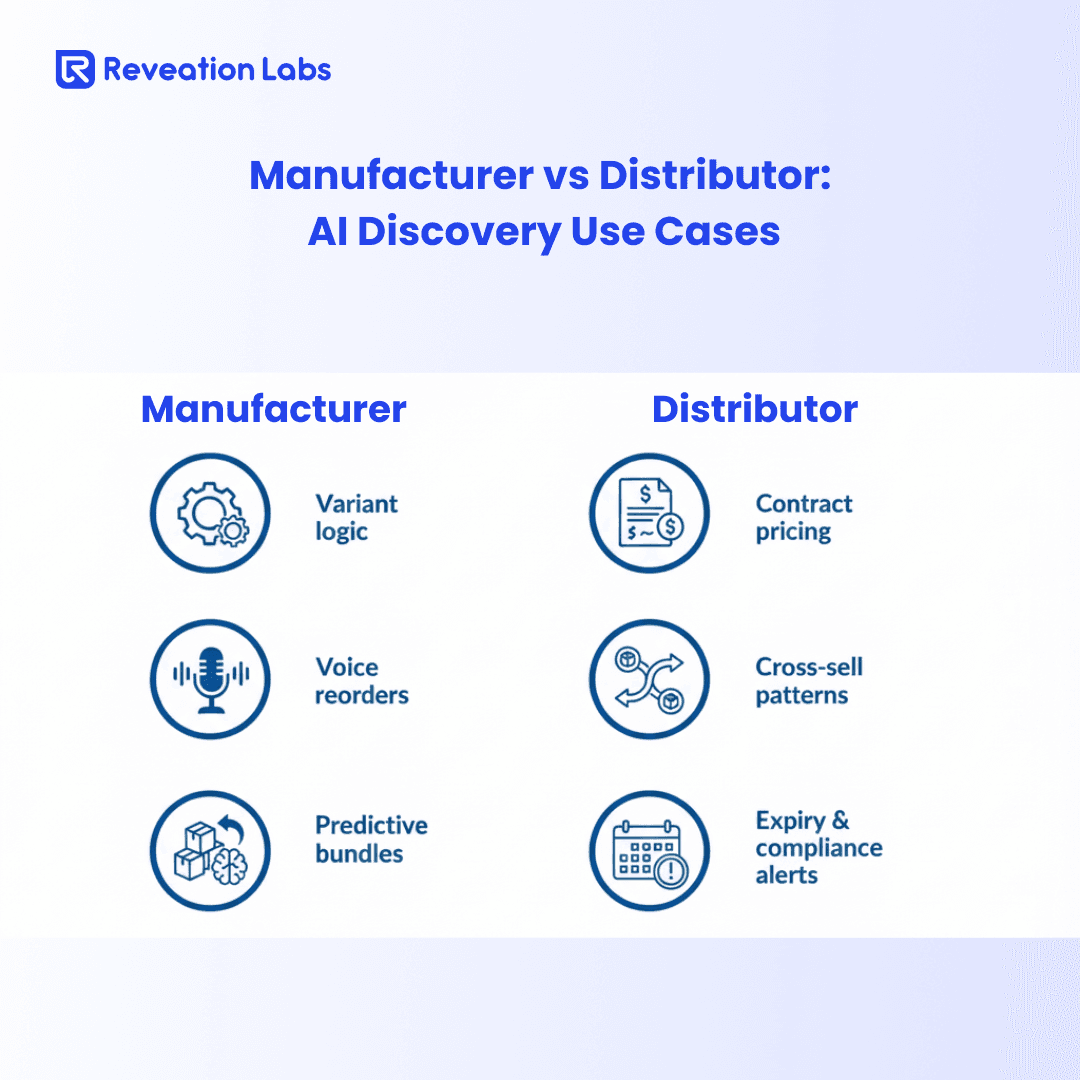
For distributors:
AI-driven upselling increases average order value by 10 to 20 percent. Recommendations are based on cart data, browsing behavior, and past purchases to surface relevant add-ons.
For manufacturers:
Voice-based reordering simplifies procurement across large catalogs. Buyers can place complex repeat orders using natural language, including product history and variant upgrades.
Implementation requirements
- Advanced search: Integrate tools like Algolia or Coveo
- Structured product data: Specifications, use cases, compatibility
- Conversational AI: Industry-aware intent recognition
- Feedback loops: Track engagement to improve recommendations
What’s changing next
Agentic AI will make autonomous purchasing decisions. These systems compare options, apply constraints, and complete transactions with minimal human input.
Headless Architectures: Why B2B Ecommerce Trends Favor Decoupling
Still stuck on a monolithic platform that takes months to update? Many mid-market manufacturers are moving to headless commerce to decouple the customer experience from backend systems.
The real advantage is omnichannel agility.
Your sales team can access the same product catalog through a mobile app, your distributors through a custom portal, and your direct buyers through an optimized web storefront, all powered by the same backend APIs.
Platform Options for Manufacturers and Distributors
Best For: Distributors prioritizing mobile PDPs
Key Advantage: Low-cost entry, fast launch, proven B2C-to-B2B migration path
BigCommerce
Best For: Manufacturers needing robust APIs
Key Advantage: High scalability, extensive B2B features, 90%+ API coverage
Strapi
Best For: Custom catalog requirements
Key Advantage: Visual editing, flexible content modeling, open-source foundation
Commercetools
Best For: Large enterprises
Key Advantage: Enterprise-grade composability, complex workflow support
What manufacturers need to get right before choosing headless
The wrong platform creates friction fast. Catalogs break, teams rely on workarounds, and product data stops scaling.
- Shopify headless fits simpler, growth-stage catalogs.
- It struggles with high SKU volume and complex product relationships.
- Variant-heavy products and compatibility logic need stronger tooling.
- BigCommerce handles large B2B catalogs out of the box.
- It supports advanced pricing, complex data, and enterprise customization.
Why headless is an advantage for distributors
Different buyers behave differently. One interface does not work for all.
- Mobile and desktop experiences can be optimized separately.
- Mobile buyers need speed. Desktop buyers need depth.
- Procurement, maintenance, and finance require different views.
- Headless eCommerce enables this without rebuilding the core platform.
This is already proven at scale
Composable commerce is established, not experimental.
- Nike delivers consistent experiences across regions and channels.
- Lululemon personalizes journeys without platform lock-in.
- Tesla connects digital and physical buying globally.
Composability: The Non-Negotiable B2B Ecommerce Trend
If your platform cannot integrate a new pricing or inventory engine within weeks, it is already slowing you down.
MACH architecture has become the default for B2B brands that need agility and scale.
Instead of relying on one monolithic system, composable commerce allows teams to combine best-of-breed tools for pricing, search, content, and inventory, without rebuilding the entire stack.
How manufacturers use composable systems
- Integrated predictive demand: Connect forecasting tools to recommend bundles and maintenance kits based on buying patterns.
- Automated contract workflows: Tools like Core DNA trigger alerts for expiring contracts and volume thresholds.
How distributors leverage composability
- Expiry-aware commerce: Integrate lot tracking and expiration data directly into the buying experience.
- Real-time dynamic pricing: Pricing microservices update contract, volume, and region-based pricing across channels.
Avoiding Composability Pitfalls
Vendor lock-in risk:
The flexibility of composable commerce can become a trap if you choose proprietary systems that don't play well with others. Mitigate this by demanding open APIs and maintaining integration documentation.
Integration complexity:
More tools mean more connections to maintain. Start with 3-5 core microservices rather than trying to decompose everything at once. Focus on the components that deliver immediate ROI, like search and pricing.
Your 2026 action plan for B2B ecommerce trends
Q1: Discovery and audit
This phase is best led through B2B eCommerce consulting:
- Catalog readiness: Review attributes for GEO and AI discoverability
- Content gaps: Identify missing specs and weak product descriptions
- Buyer friction: Map where AI copilots reduce steps
- Baseline metrics: Capture discovery-to-conversion performance
Q2: Foundation migration
- Headless setup: Implement a headless CMS like Shopify Plus for distributors or BigCommerce for manufacturers
- GEO groundwork: Apply semantic tagging
- Structured data: Add schema for specs and pricing
- API layer: Prepare for future microservices
Q3: GEO optimization and testing
- Semantic coverage: Tag the full product catalog
- Buyer language: Add Q&A-style content based on real queries
- AI testing: Validate visibility in tools like ChatGPT, Perplexity, and Claude
- Performance tuning: Refine based on AI responses
- Conversion goal: Target up to 40 percent lift from better discovery
Q4: AI Copilot deployment
- Conversational discovery: Launch AI search or recommendations
- Revenue expansion: Activate upsell and cross-sell logic targeting 10 to 20 percent AOV lift
- Reordering automation: Enable chat or voice-based repeat orders
- Measurement: Track discovery-to-conversion KPIs
- ROI target: Expect 20 to 40 percent revenue impact from improved discovery
Making B2B eCommerce Trends Work for Your Business
AI-ready content, headless flexibility, and composable architecture are no longer optional.
By 2026, B2B buyers expect conversational product discovery that understands complex requirements.
Traditional catalog search is fading fast, replaced by AI agents that navigate inventory more efficiently than manual workflows.
For manufacturers:
Structure technical specifications for AI visibility. When formatted correctly, existing engineering data becomes a discovery and conversion advantage.
For distributors:
Expose pricing logic and inventory availability through APIs. The distributor that is easiest for AI copilots to evaluate and recommend wins the transaction.
The B2B eCommerce trends shaping 2026 reward early movers with visibility, higher conversion, and a durable advantage.
Reveation Labs has done this in practice and can help you lead the transition.