
Most B2B eCommerce trend roundups still sound familiar. They talk about personalization, omnichannel, and AI as if the conversation has not moved forward.
In 2026, the bigger story is not whether digital matters. It is where buying is changing fastest, where friction is still costing revenue, and where leadership teams need to fix foundations before adding more surface-level features.
That is why the most useful lens for B2B eCommerce trends 2026 is not “what is new?” It is “what is now impossible to ignore?”
Buyer behavior is continuing to shift toward self-serve evaluation and digital decision-making. More leaders are realizing that the issue is no longer whether buyers want digital options. The issue is whether current systems actually support how modern B2B buying works.
Across manufacturers, distributors, and complex sellers, three shifts stand out in 2026: AI is influencing buying earlier, product discovery is becoming a bigger commercial issue than storefront polish, and architecture is moving from back-office concern to growth constraint.
Why B2B eCommerce trends in 2026 feel different
What leaders keep hearing is mostly true, but incomplete. Yes, buyers want self-service. Yes, AI is accelerating. Yes, B2B experiences are borrowing more from B2C.
But those are no longer surprising observations. The more useful insight is that the pressure has shifted from front-end improvement to operational readiness. Many teams are still trying to solve 2026 problems with 2022 priorities.
They invest in redesigns, extra content, and new tools while leaving product data, search logic, pricing rules, and system ownership messy underneath. That is why some companies launch modern-looking experiences that still do not reduce buying friction.
This is also why conversations around modern B2B eCommerce solutions are changing. The focus is moving away from “launch a portal” and toward building a buying system that actually works under complexity.
Shift 1 — AI is shaping B2B buying before your sales team gets a shot
The freshest change in B2B eCommerce is not that AI exists. It is that AI is starting to influence supplier evaluation before a seller has any direct involvement.
That does not mean sales disappear. It means sales gets pulled later into the journey, often for exceptions, negotiation, account strategy, and complex approvals. The early buying work increasingly depends on whether your product content, category structure, availability signals, pricing logic, and workflow steps are usable by both humans and AI-assisted journeys.
This is the practical side of what many teams are now calling agentic commerce in B2B eCommerce. For leaders, the important takeaway is simple: AI will not rescue a broken buying experience. It will expose one faster.
In 2026, AI is not the strategy. Readiness is the strategy.
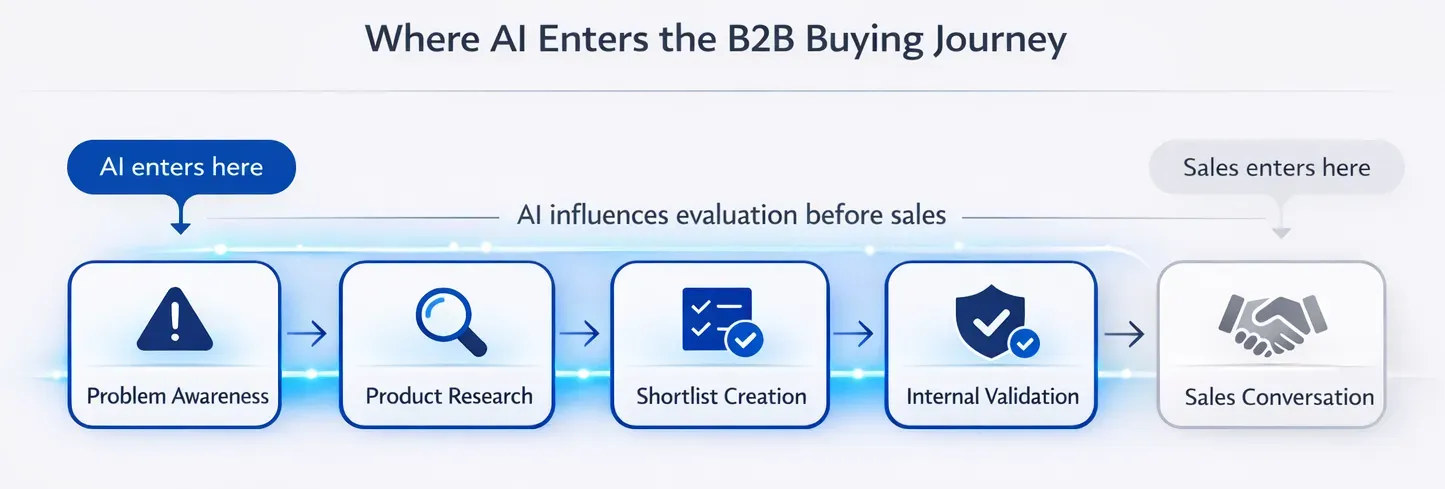
If product data is inconsistent, rules live in people’s heads, and the portal only works for customers who already know what to order, AI will magnify those gaps instead of smoothing them over. That is why teams should create clean product truth, structured commercial rules, and clear quote-to-order actions before chasing flashy AI use cases.
Failed approaches leaders should avoid
The broader strategic implication is that leaders should stop asking where AI can be “added.” They should start asking where buying can be made easier before human intervention is required. That is where AI becomes commercially useful in B2B.
Shift 2 — Product discovery is becoming more important than storefront design
Many B2B companies still believe their digital issue is presentation. In reality, it is often discovery.
A polished storefront does not help much if buyers cannot quickly find the right SKU, compare compatible options, understand configuration limits, or know whether the product fits their account context. That is why B2B eCommerce search that understands your industry matters more than generic search experiences.
This is especially important in complex catalogs. Buyers may search by part number, industry shorthand, spec ranges, replacement use case, equipment compatibility, or internal naming conventions that do not match your site taxonomy. When search cannot interpret that reality, buyers bounce, call, or email instead.
There is also a second discovery problem that more companies are waking up to in 2026: visibility. As Reveation explains in its piece on customer portal SEO, portals are built for account-specific actions, while storefronts and public product pages are built for discovery.
If new buyers cannot find what you sell without a login, your digital experience may serve retention while quietly limiting acquisition. That is why product discovery now deserves executive attention. It affects conversion, self-service adoption, support volume, and how easily new accounts can enter the journey.
Shift 3 — Your commerce architecture is now either accelerating growth or slowing it down
Architecture used to be discussed mainly in IT terms. In 2026, it is increasingly a commercial issue.
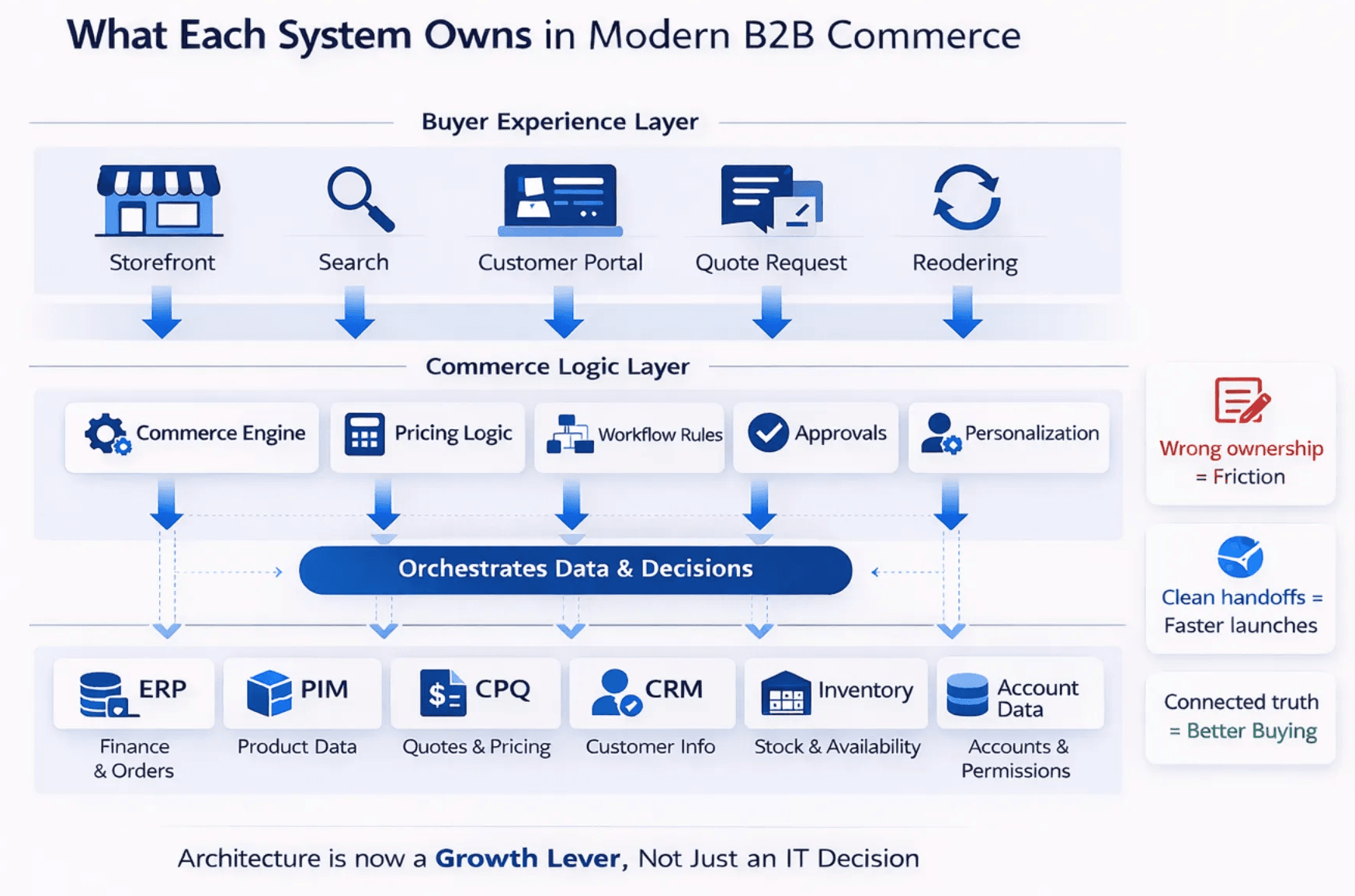
When ERP, PIM, CPQ, CRM, search, and commerce operate as loosely aligned systems, the consequences show up in the customer experience. Wrong product details, inconsistent pricing, slow launches, brittle workflows, and channel confusion all start to pile up.
That is why streamlining B2B eCommerce architecture is becoming a growth conversation rather than just a platform conversation. The appeal of composable B2B commerce is not just modernity. It is control.
Teams want an architecture that lets them adapt without rebuilding everything, integrates more cleanly with source systems, and supports complex B2B workflows without over-customizing a monolith. But composability is not automatically the answer. If governance is weak, a modular stack can simply create more moving parts to manage.
This is where many organizations need a reset. The real question is not “Should we go composable?” It is “What should each system own, and what is the simplest architecture that can support our buying model over the next few years?”
A practical decision framework for 2026
What B2B leaders should prioritize first in 2026
The smartest teams will not try to modernize everything at once. They will fix what the three shifts have made impossible to ignore.
Start with product data quality before experience redesign.
Fix discovery friction before investing in cosmetic storefront upgrades.
Clarify system roles and ownership before adding more tools.
A useful benchmark is not whether the platform looks modern. It is whether the current setup helps buyers progress with confidence and helps internal teams execute without workarounds. If not, that is where effort should go first.
For teams already assessing next steps, Reveation’s work on signs your B2B eCommerce platform is holding you back is a practical place to pressure-test the current stack. And if the gap is execution, not strategy, B2B eCommerce implementation support can help turn priorities into a cleaner rollout.
The companies that win in 2026 will not be the ones talking most about trends. They will be the ones removing the friction those trends expose.
Final takeaway
The biggest B2B eCommerce trends in 2026 are not cosmetic. They are structural. AI is influencing buyers earlier. Product discovery is becoming a competitive battleground. Architecture is deciding whether commerce becomes easier to scale or harder to manage.
That is why leaders should resist shallow trend thinking. The opportunity is not to chase every new idea. It is to make buying easier, clearer, and more connected across the full journey.
Companies that do that will be better positioned for AI-assisted buying, stronger self-service adoption, and more durable digital growth. To explore what that looks like in practice, Reveation’s B2B eCommerce services and B2B eCommerce platform work offer a useful next step.
Ready to simplify your B2B eCommerce growth?
If you're evaluating your current setup, fixing buying friction, or planning your next commerce move, now is the right time to align the foundation.