Agentic AI vs Generative AI in B2B
78% of buyers choose whoever responds first.
That's not marketing hype; that's what happens when B2B companies take 29 hours on average to respond to leads while competitors answer in minutes.
The gap isn't about hiring faster teams. It's about which type of AI you're using.
Most B2B leaders know they "need AI," but often grapple with what is Gen AI vs AI. The problem: They're deploying the wrong kind for the problem they're trying to solve.
By 2028, 33% of enterprise software will embed agentic AI, up from under 1% in 2024. Companies that understand the difference now get a 3-year head start.
Here's what actually separates them, clarifying what is the difference between AI and generative AI, and where each one wins.
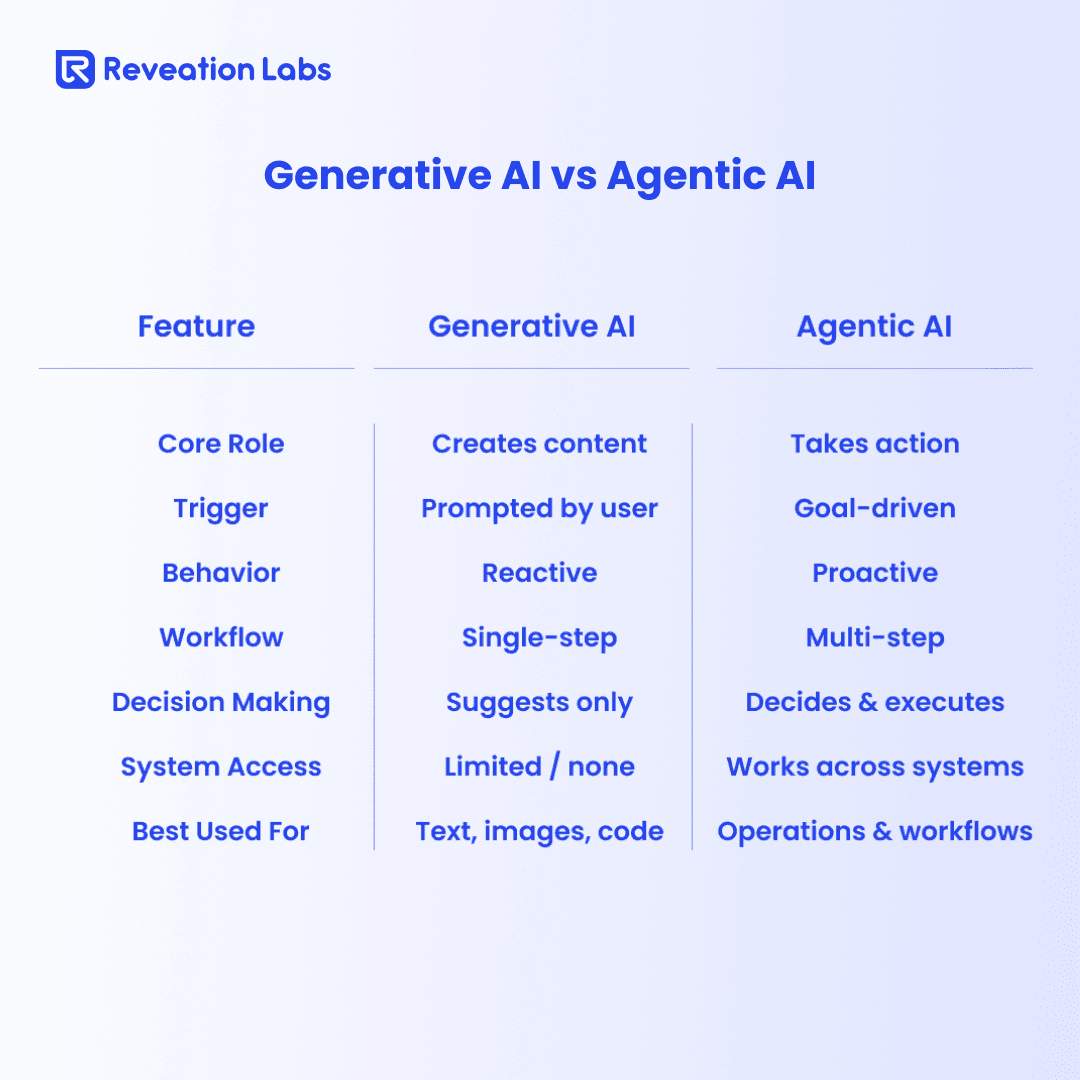
The Core Difference
Generative AI creates content, highlighting which are use cases of generative AI such as producing text or images when asked, then stops, like ChatGPT.
Agentic AI achieves goals. You set an objective, it monitors systems, makes decisions, takes actions across multiple platforms, and learns from results. Think autonomous operations.
| What You Need | Use This | Real Example |
|---|---|---|
| Write 500 product descriptions | Generative AI | Input SKU data → AI writes descriptions → you review |
| Keep inventory optimized | Agentic AI | Agent monitors stock → predicts shortage → requests quotes → selects supplier → places order → updates ERP |
| Draft customer emails | Generative AI | "Write follow-up" → AI drafts email → you send |
| Prevent customer churn | Agentic AI | Agent detects 45-day gap in orders → analyzes history → drafts personalized outreach → schedules send → books call if no response |
Simple rule: If a human must decide every next step, you want Generative AI. If the workflow has clear rules and crosses systems, you want Agentic AI.
Where Generative AI Actually Works
1. Content That Scales
Considering generative AI websites examples, 77% of B2B eCommerce professionals use AI daily, primarily for content creation (see EComposer research in Sources). The efficiency is real: what took hours now takes minutes.
Good for:
- Updating 10,000+ product descriptions
- Writing technical documentation
- Creating buying guides
- Drafting customer communication templates
The catch: You still need humans to review, approve, and publish. It's a speed multiplier, not a replacement.
2. Marketing Automation
Companies successfully learning how to use AI for marketing automation report 20-30% higher campaign ROI compared to peers. 48.9% of retail companies now use AI to automate campaigns (EComposer research).
The win is in personalization at scale. AI can segment audiences, tailor messaging by role or industry, and generate variations faster than any human team.
What it doesn't do: Decide when to send that campaign, what happens if someone doesn't respond, or how to coordinate across multiple channels.
3. Support Team Efficiency
31% of retail companies use AI chatbots and virtual agents (EComposer), cutting response times by up to 99%.
Generative AI use cases include draft answers, summarizing tickets, and translating technical responses. 64% of sales reps save 1-5 hours weekly through AI automation.
The limit: Edge cases, judgment calls, and anything requiring relationship management still need humans.
Where Agentic AI Takes Over (With Real Numbers)
1. Autonomous Procurement
The Walmart Case: A prime example of an effective GPT procurement strategy, Walmart deployed Pactum's AI negotiation chatbot to handle supplier contracts autonomously. The results:
- 68% success rate reaching agreements (vs. 20% target)
- Average 3% savings on each negotiated contract
- 4x ROI on the platform investment
- 11-day average negotiation turnaround (vs. weeks manually)
- 75% of suppliers preferred negotiating with the AI over humans
- 83% found the chatbot easy to use
The AI now handles negotiations with 2,000 suppliers simultaneously, something impossible for any human team.
What the agent does:
- Monitors inventory levels and lead times
- Predicts upcoming stockouts
- Requests quotes from approved suppliers
- Negotiates within defined guardrails
- Routes only exceptions to human buyers
- Applies terms automatically in ERP systems
What fails:
- Complex custom manufacturing quotes
- Strategic supplier relationships requiring judgment
- First-time vendors with unclear requirements
- Heavily regulated industries with approval chains
Real talk: Walmart spent months integrating systems and training the model. It's not plug-and-play, but value typically ranges from 2-30% on negotiated spend (Pactum research).
2. Speed-to-Lead Automation
The problem (all data from Martal Group research):
- 78% of customers buy from whoever responds first
- Average B2B response time: 29 hours
- Only 17% of companies respond instantly
- 63% of businesses don't respond to inbound leads at all
What agentic AI does:
- Monitors form submissions 24/7
- Scores leads based on behavior and fit
- Triggers personalized outreach within minutes
- Books meetings automatically
- Updates CRM without human input
- Escalates only high-value leads to sales
Companies responding within 5 minutes are 100 times more likely to connect with leads than those waiting 30 minutes.
3. Proactive Customer Success
Most customer success is reactive, waiting for complaints or renewal notices.
Agentic AI flips this by:
- Monitoring order and shipment status in real-time
- Detecting delays or recurring issues
- Checking alternative fulfillment options
- Triggering proactive outreach before customers complain
- Updating account records automatically
This cuts ticket volumes because issues are handled before they escalate. Generative AI can help write the outreach email, but the decision to act and the cross-system orchestration belong to agentic AI.
The Implementation Reality (What They Don't Tell You)
What Actually Fails
Gartner predicts 40% of agentic AI projects will be canceled by the end of 2027 (see Gartner research in Sources) due to:
- Escalating costs
- Unclear business value
- Inadequate risk controls
According to Gartner's January 2025 poll:
- 19% made significant investments in agentic AI
- 42% made conservative investments
- 31% taking a wait-and-see approach
Only 42% of companies achieve their AI ROI targets (Optif research) in the first year.
Companies that succeed focus on:
Start with clear ROI metrics
- Not "let's try AI" but "this process costs us $X annually, AI should reduce it by Y%."
Integration is everything
- The Walmart case worked because they integrated with ERP, procurement, and legal systems
- Half-implemented solutions fail
Pilot before scaling
- Walmart started with tail-end suppliers (lower risk)
- Proved ROI before expanding to mid-tier suppliers
Accept the timeline
- Walmart: 3-month pilot + months of integration
- Financial services: 60% see payback within 9 months (Cubeo research)
- Retail: Similar timelines
The Power Move: Use Both Together
The best B2B setups pair both types of AI.
Example workflow:
- Agent detects: Customer hasn't reordered in 45 days (breaks their pattern)
- Agent analyzes: Purchase history, contract terms, seasonal trends, open tickets
- Generative AI: Drafts personalized email referencing previous orders, suggests alternatives
- Agent schedules: Sends at the time when customer typically engages (learned from past behavior)
- Agent escalates: If no response in 48 hours, books a call slot in the account manager's calendar with a brief
- Agent learns: Records result, updates playbook for similar situations
The customer experiences personal attention. Your team didn't manually trigger any of it.
When to favor each:
- Generative AI: Content, analysis, draft responses
- Agentic AI: Multi-system coordination, decisions that follow clear rules
- Both: Customer journeys mixing content, timing, and operational steps
What the Data Says About ROI
Proven Returns:
- Marketing teams: 300% average ROI from AI implementations
- B2B sales: 280% ROI in year 1 (Forrester)
- Contact centers: 20-40% cost reduction with autonomous agents (Orbilon research)
- Healthcare documentation: 42% reduction in daily time spent (Orbilon research)
Adoption Reality:
- 89% of revenue organizations now use AI-powered tools, up from 34% in 2023 (Optif)
- 81% of sales teams experimenting with or fully deployed AI (Cirrus Insight)
- 87% of sales leaders report pressure from CEOs/boards to deploy generative AI (Cirrus Insight)
- 43% of sales reps actively use AI, up from 24% in 2023—a 79% year-over-year increase (Cirrus Insight)
Performance Impact:
- Sellers using AI effectively are 3.7x more likely to meet quota (Gartner via Cirrus Insight)
- Only 25% of B2B reps hit quota in 2024, down from 70% historically
- AI could double active selling time by eliminating routine tasks (Bain via Cirrus Insight)
The Practical Path Forward
Most teams don't need a complex AI stack on day one.
Start here:
Audit high-friction workflows
- Where do quotes get stuck?
- Where do orders stall?
- Where do buyers drop off from waiting?
Time your current process
- If your last 5 quotes took >8 hours average, agentic automation pays off
- If lead response averages >1 hour, you're losing deals
Pilot with clear metrics
- Not "let's try AI"
- But "reduce quote time from 6 hours to 2 hours in 90 days"
Start with Generative, scale to Agentic
- Use Generative AI for content operations first (lower risk, faster ROI)
- Then identify 1-2 workflows where agents can remove days of delay
- Integrate deeply (half-measures fail)
The Bottom Line
By 2028, 33% of enterprise software will include agentic AI (Gartner). That's in 2 years.
Companies deploying now get the learning curve behind them, while competitors are still in pilot phases.
But here's what matters more than timing: deploying the right AI for the right problem.
Generative AI speeds up what humans create. Agentic AI removes the need for humans to orchestrate multi-step workflows.
Use Generative AI where you need content and speed. Use Agentic AI where you need decisions and orchestration. Use both where customer journeys require content, timing, and operational coordination.
The window for advantage is open. It won't stay open long.