
Updated by Sara on March 31, 2026
AI tool adoption
89%
B2B buyers are using AI tools like ChatGPT, Claude, and Perplexity throughout their buying journey.
Research behavior shift
71%
Increase in buyers starting their research in AI chatbots instead of Google in just four months.
Traffic shift forecast
25%
Gartner predicts that 25% of organic search traffic will shift to AI chatbots by 2026.
Why AEO Is a Game-Changer for B2B in 2026
AI assistants are now the first touchpoint for many B2B buyers, answering questions before a human ever reaches your website. With AI handling more of the initial discovery process, only content structured specifically for answer engines is likely to get surfaced.
Without AEO strategies, brands lose visibility, context, and influence during a critical automated conversation. The shift is not subtle; it is changing how discovery, evaluation, and purchasing happen in B2B online marketing.
What's standing between your sales pipeline and AI-powered buyers?
The answer is simple: presence in AI-generated answers. Companies adopting AEO strategies early are already seeing meaningful returns. Early AEO adopters achieve 287-415% ROI within 90-120 days, with AI-sourced traffic converting at rates 25 times higher than traditional organic search.
ROI within 90-120 days
287-415%
AI-sourced traffic conversion
25x
Traditional organic search vs AI-sourced traffic
Compare this to traditional SEO, which often takes 6-12 months to show measurable momentum. AI traffic arrives differently, educated, ready for evaluation, and primed for conversion.
Traditional search engines like Google see about 1.41% click-through rates on average, but when your brand is cited in AI-generated answers, click behavior often looks different because users get more context before they ever visit your site. That makes AI visibility less about raw clicks and more about earning higher-intent engagement.
Gartner predicts that 25% of organic search traffic will shift to AI chatbots by 2026. This isn't a distant possibility. This is happening now.
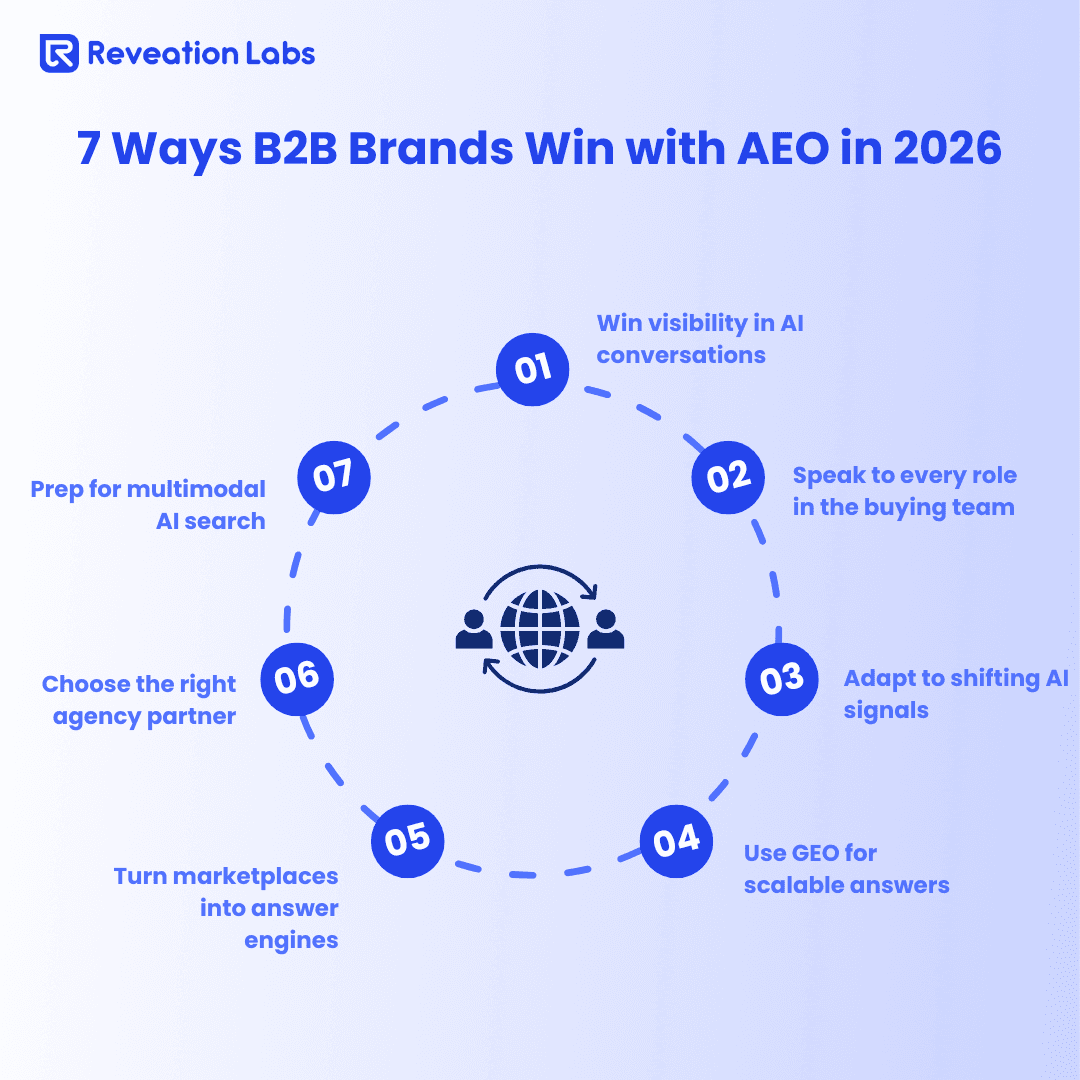
1. Win Visibility by Owning AI-Powered Conversations
AI answers before clicks, which means only content structured for answer engines gets surfaced. Your b2b online marketing must shift from ranking web pages to being the answer itself.
Here's what works: focus on conversational, clean, high-signal answers that match the exact phrasing buyers use.
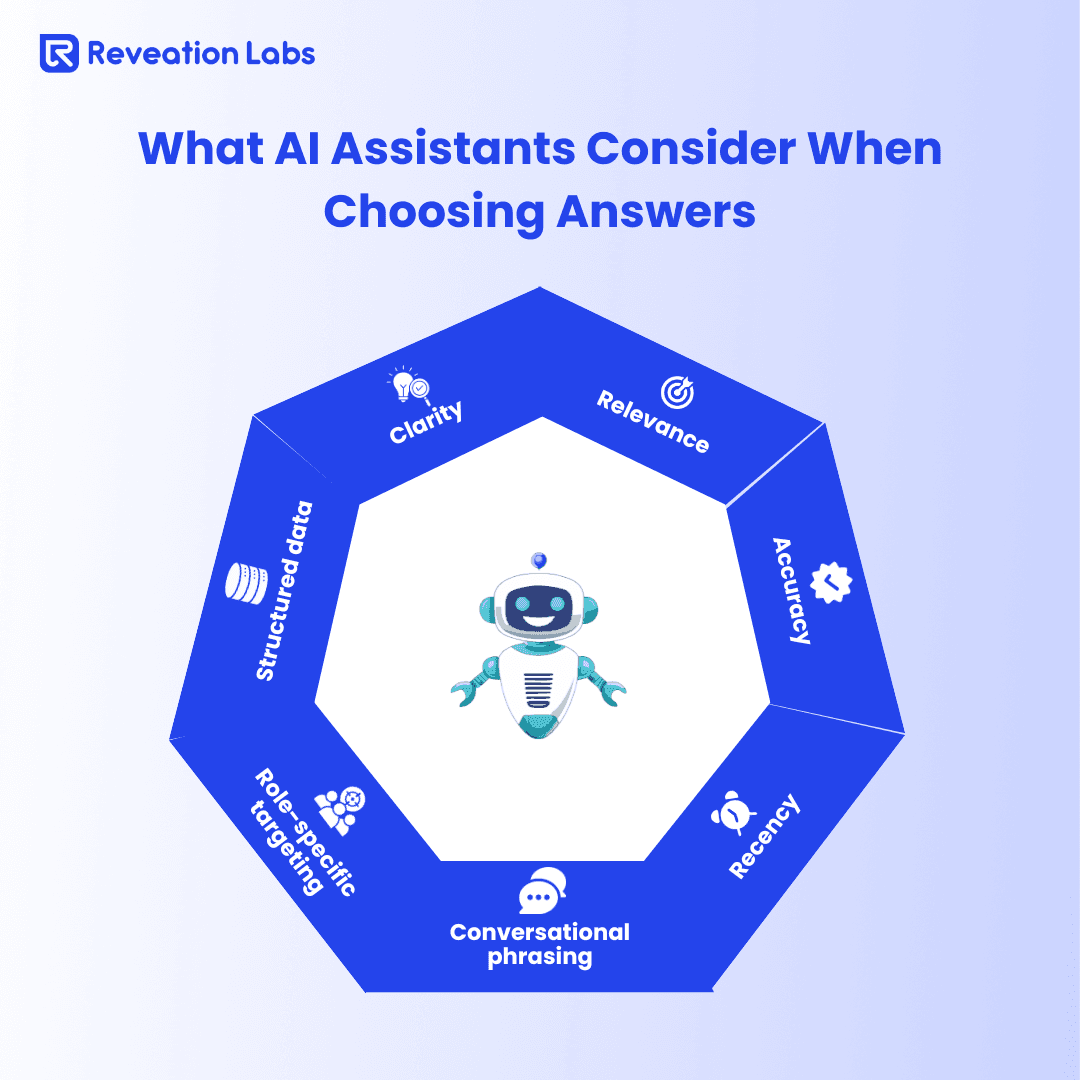
Avoid long, complicated paragraphs filled with technical jargon. AI engines are not impressed by fluff. Instead, structure your content in short, direct sentences with clear answers near the top. AI models prioritize clarity, specificity, and original research over promotional language.
Deprioritized
- Long, complicated paragraphs filled with technical jargon
- Fluff
- If your homepage reads like a brochure, AI engines will deprioritize it
Surfaced
- Conversational, clean, high-signal answers
- Short, direct sentences with clear answers near the top
- Direct answers, structured data, and conversational tone
A useful tip: Use the exact questions buyers say out loud, not how marketing teams wish they'd sound.
Your sales team hears these questions every single day. Mine those conversations. Record common objections. Document the prompt variations your prospects use when querying AI systems.
Research shows buyers use 37-120+ different prompt variations when asking AI questions. Document these variations and optimize your content around them.
Are your product pages whispering when they should be shouting in AI rooms?
If your homepage reads like a brochure, AI engines will deprioritize it. The takeaway is clear: you win visibility by speaking the language AI listens for, direct answers, structured data, and conversational tone.
2. Win Trust by Tailoring Answers to Each Decision Maker
B2B buying involves a small crowd, but each person cares about different outcomes. In 79% of B2B purchases, the CFO holds final decision-making power.
But the CFO isn't the only voice in the room. The IT manager evaluates security and integration. The procurement lead cares about vendor stability and contract terms. The end user wants ease of use.
AEO strategies for B2B companies must segment answers by role:
CFO
Searches for ROI, total cost of ownership, and competitive advantage.
IT manager
Evaluates security and integration.
Procurement lead
Cares about vendor stability and contract terms.
End user
Wants ease of use.
Build role-based answer sets for each decision maker in the buying committee. The CFO searches for ROI, total cost of ownership, and competitive advantage. The technical buyer searches for integration requirements and security certifications. The procurement officer searches for vendor references and compliance documentation.
Each stakeholder feels directly spoken to when your content addresses their specific pain point.
Could a CFO and an IT lead find your answers easily without feeling lost? If both roles see the same generic answer, neither feels acknowledged.
Use structured data markup to segment your answers by audience and buyer journey stage. The takeaway is that you win trust when every stakeholder feels directly addressed, not when you blast a one-size-fits-all message at everyone.
3. Win Relevance by Updating Content to Match Evolving AI Signals
AI engines shift their ranking patterns frequently, and stale content drops faster than most brands expect. The algorithms change. The platforms evolve. Your content must evolve, too.
Your b2b online marketing agency should track trending question patterns:
Monitor what buyers ask ChatGPT, Perplexity, and Claude. Refresh answers with new data points, clearer phrasing, and updated formats. If your competitive analysis blog post is from 2023, AI engines will likely cite fresher alternatives.
Treat answer content as a living asset, not a "set it and forget it" page.
Fresh, updated web mentions vs stale content
Brands in the top quartile for fresh, updated web mentions receive 10 times more AI citations than brands with stale content. Is your content stuck in 2023 when buyers are searching in 2026? If so, your AEO strategies have already lost momentum.
Commit to a quarterly content refresh cycle.
Update case studies with new results. Refresh pricing pages with current data. Rewrite comparisons as competitors evolve.
The takeaway is that you win relevance by treating answer content as a continuous improvement project, not a one-time investment.
4. Win Speed and Scale Using Generative Engine Optimization (GEO)
Generative engine optimization services boost AEO by generating dynamic, AI-ready responses at scale. GEO is the practice of optimizing content and website structure for AI-driven generative models so your message is represented accurately and consistently.
Here's how GEO amplifies AEO strategies: Use AI tools to rapidly create fresh, buyer-focused answers, then review everything for accuracy, tone, and compliance before publishing.
Step 1
Use AI tools to rapidly create fresh, buyer-focused answers.
Step 2
Review everything for accuracy, tone, and compliance before publishing.
Step 3
Implement structured data markup, clean HTML hierarchies, and semantic clarity.
Generative engine optimization features allow marketers to scale content creation while maintaining quality.
A generative engine optimization geo marketing agency can help you implement structured data markup, clean HTML hierarchies, and semantic clarity that helps AI engines understand your content.
Schema markup on FAQs, product pages, and service descriptions makes your answers machine-readable.
How can AI not only find your answers but help you create better ones swiftly?
By using generative engine optimization, you automate the scaling process without sacrificing accuracy. The takeaway is clear: you win scale when AI helps you build AI-ready content at velocity.
Pairing AEO with modern b2b ecommerce solutions gives B2B brands a competitive edge by helping buyers find accurate answers faster and complete purchases with less friction.
5. Win Placement on B2B Marketplaces Through AI-Friendly Formatting
B2B online marketplaces like Amazon Business, Alibaba, and industry-specific platforms are rising as primary data sources for AI assistants. These platforms are where buyers browse, compare, and decide.
Optimize product data, specs, and FAQs so marketplace AI can lift your answers directly into recommendations.
Amazon Business
Uses AI to recommend products based on company purchase history and buyer behavior.
Alibaba
Uses AI chatbots to provide personalized recommendations based on browsing patterns.
Your marketplace listings are now content distribution channels for AI engines. Align your marketplace content structure with your website's AEO structure. Use consistent product descriptions. Use the same terminology on your website and your marketplace.
Amazon Business uses AI to recommend products based on company purchase history and buyer behavior.
Alibaba uses AI chatbots to provide personalized recommendations based on browsing patterns. Is your marketplace product listing acting as an AI answer magnet? If your Alibaba or Amazon Business product data is poorly structured, you're leaving conversions on the table.
The takeaway is that you win new buyers where they already shop and search.
Your b2b online marketplace presence is no longer just a sales channel, it's a content distribution channel for AI engines.
6. Win Expertise by Choosing the Right AEO + GEO Agency Partner
Remember, it's not GEO vs SEO or SEO vs AEO anymore. The right agency can use all of them together for maximum benefit.
Not every B2B online marketing agency understands the new AI answer ecosystem. Many are still stuck in 2020-era SEO thinking.
Look for deep technical SEO experience combined with AI-first thinking.
Ask for AEO metrics, proven use cases, and transparent tools. What does their AEO strategy look like? How do they measure AI Share of Voice? Can they show you citation frequency data?
A B2B online marketing agency worth its salt will have implemented generative engine optimization features across its own content first.
They'll show you before-and-after metrics from AI visibility improvements. They'll discuss schema markup implementation, FAQ optimization, and citation tracking.
Ask for case studies, ask how they approach GEO, and what generative engine optimization services they actually offer.
Some agencies still don't have true AEO strategies for B2B companies. Some are guessing. The best partners have spent the last 12-18 months building genuine expertise.
How confident are you that your agency truly understands the AI answer ecosystem?
If they can't articulate the difference between traditional SEO and AEO strategies, that's a red flag. The takeaway is that you win faster when your agency isn't learning on your dime.
7. Win the Future by Preparing for Voice, Visual & Multi-Modal AI Search
Text is only one dimension of AEO strategies. AI engines increasingly analyze voice queries, images, diagrams, videos, and technical PDFs.
Voice assistant transactions are projected to reach $164 billion by 2025, reflecting a 320% increase from 2020.
Multimodal search is taking center stage, blending voice, image, video, and traditional text to deliver more intuitive results.
Projected voice assistant transactions
$164B
Increase from 2020
320%
Imagine a buyer asking ChatGPT aloud, "Show me the best B2B invoicing software for our tech company," and receiving not just text but a video demo, comparison charts, and user reviews, all in one response.
Add structured captions, clean alt-text, and voice-friendly Q&A formats to your content.
Experiment early with multimodal answers while competitors lag. Use timestamps and chapters on your videos. Add on-screen text and closed captions for better indexing. Host videos on SEO-friendly platforms like YouTube and embed them on your site with supporting content.
Voice search optimization requires conversational keywords and phrases.
Instead of targeting "invoicing software comparison," target "What's the best invoicing software for tech companies with remote teams?". Long-tail keywords and question-based queries are the currency of voice-powered AEO strategies.
Are you ready for your AI search engine results to speak, see, and show your value?
If your content is text-only, you're not ready for 2026. The takeaway is that you win long-term by optimizing for every way buyers consume answers.
Your Path Forward
AEO strategies for B2B companies aren't optional anymore. They're essential.
Brands invisible in AI search
34.5%
Even when they rank well in Google.
Brands with high recognition
60-80%
Appear in relevant AI searches.
Low-recognition brands
Less than 15%
Appear in relevant AI searches.
34.5% of brands are completely invisible in AI search, even when they rank well in Google. Brands with high recognition appear in 60-80% of relevant AI searches. Low-recognition brands? Less than 15%.
Companies implementing AEO strategies achieve 287-415% ROI within 90-120 days.
AI-sourced traffic converts 25 times higher than traditional organic search. The first-mover advantage window is open right now, but it's closing fast.
Start by mapping your complete question ecosystem.
Document the prompts your buyers use. Structure your content for AI engines, not just search bots. Segment answers by decision-maker role. Implement schema markup on your top pages.
Refresh stale content regularly, track citation frequency, partner with agencies that understand GEO, and use generative engine optimization services. Prepare for voice and multimodal search.
Build your AEO strategies for B2B companies today, or watch your competitors dominate the AI-powered discovery phase tomorrow.
Reveation Labs can do it for you.
If building AEO strategies feels overwhelming, if you're unsure where to start, or if your current B2B online marketing approach isn't capturing AI-powered buyers, Reveation Labs specializes in answer engine optimization for B2B companies.
We help brands structure their content, implement GEO, track AI visibility, and win in the new AI-first discovery landscape. Your buyers are asking AI questions right now. The question is whether your answers are the ones they'll find.